


Value, benefits and routes to improve brain tumour peer support for non-standard-of-care treatment
At this year’s European Association of Neuro-Oncology (EANO) conference, I’m presenting work that is particularly important to me: exploring the value of peer support for people considering or receiving brain tumour treatments outside the standard of care, and how we can make that support better.
I have worked in neuro-oncology for more than ten years and currently work as a Neuro-oncology Clinical Research Practitioner and Network Relationship Manager at Imperial College London’s Computational Oncology Lab and Imperial College Healthcare NHS Trust.
My background is in Biomedical Science and Neuroscience, but a large part of my work has focused on something that sits alongside the science: making sure patients and caregivers have a meaningful voice in research and care.
My involvement in patient and public involvement and engagement began in 2017, when I facilitated my first focus group to help shape the Brain Wear clinical trial. Since then, I have led more than 20 PPIE groups, several co-led with patients and caregivers.
Again and again, I’ve seen how much people affected by brain tumours can learn from one another, particularly when they are facing difficult decisions or exploring treatments outside standard clinical pathways.
Why brain tumour peer support matters
A brain tumour diagnosis can leave patients and families feeling overwhelmed, isolated and uncertain about what comes next. For people considering treatments outside the standard of care, finding reliable information and connecting with others who have faced similar decisions can be particularly valuable.
Since 2024, we have been developing peer support through HINO, bringing together patients, caregivers and healthcare professionals through support groups, seminars, our website and blog.
For this project, we wanted to understand what people were actually getting from that support, where the gaps remained and what we could do to improve it.
Over a nine-month period, we used questionnaires and a focus group to hear directly from patients and caregivers. Twenty-one people responded to the questionnaire, while our wider HINO WhatsApp community has now grown to more than 100 patients and caregivers. We have also delivered more than 12 HINO seminars and a dedicated HINO Day, bringing patients and families together with clinicians and researchers working across neuro-oncology.
What we learned
One of the strongest messages was the importance of knowing that you are not navigating this alone.
As one member of the community told us:
“There are people going through the same as you. You are not alone.”
Others described the practical value of learning from people already using treatments, being able to ask questions and hearing first-hand experiences from people facing similar circumstances.
The work has also helped us identify gaps in publicly available information about treatment options and understand where HINO can provide better support.
For me, that is one of the most important aspects of peer support. It isn’t about telling someone which treatment they should choose. It is about helping people access reliable information, learn from others’ experiences, ask questions and feel better equipped to make decisions that are right for them.
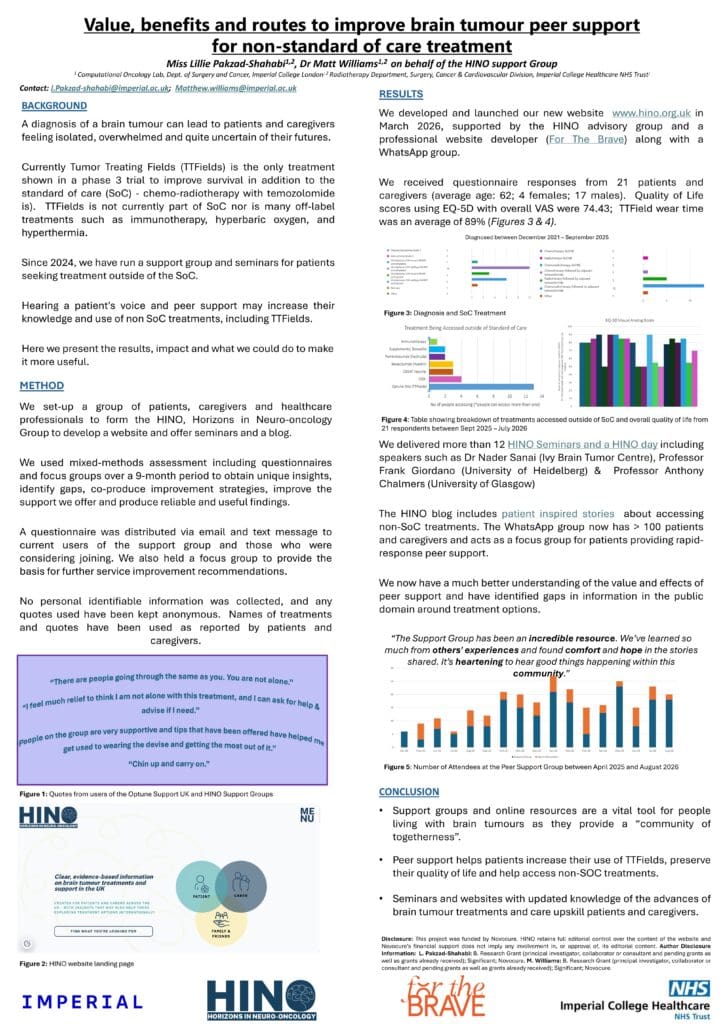
Value, benefits and routes to improve brain tumour peer support for non-standard-of-care treatment – Lillie Pakzad-Shahabi and Dr Matt Williams, EANO 2026.
Download the full EANO 2026 poster (PDF) →
Where do we go from here?
Our findings suggest that support groups, accessible online information and educational seminars can all play an important role for people living with brain tumours, particularly when they are considering treatment options outside standard care.
But this work is also about listening. Peer support should continue to develop around what patients and caregivers tell us they actually need.
At EANO 2026, I’ll be sharing what we have learned so far, the impact of the HINO support community and our recommendations for how peer support can be strengthened further.
For me, the goal is simple: to make sure that people navigating a brain tumour diagnosis have access not only to good information, but to a community where they can ask questions, share experiences and know that they are not doing this alone.
Want to connect with others navigating brain tumour treatment?
HINO brings together patients and caregivers to share experiences, ask questions and access peer support. Find out more about the HINO support community and how to get involved.
